Fact Checked by


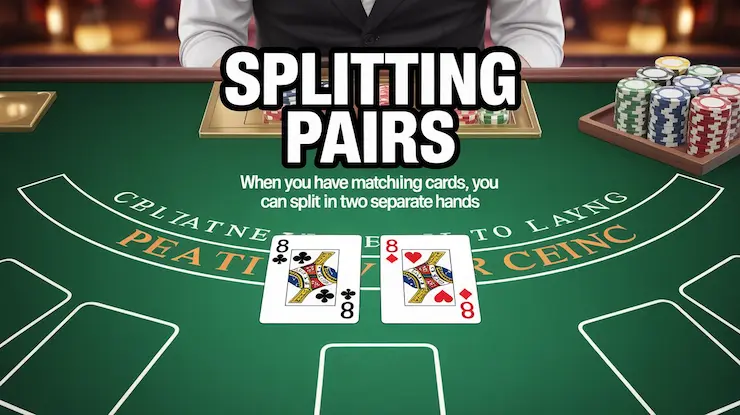
A blackjack split is one of the most powerful tools in the player’s arsenal. It helps you avoid costly mistakes and, more importantly, allows you to maximize your edge when executed correctly.
On the other hand, a poorly timed split can erase your advantage, so it’s crucial that you know when to take this action. To that end, we’ve prepared detailed explanations and charts to help you understand how this splitting works and when it can be used to your benefit.
When to Split in Blackjack
We’ll show you when to split in blackjack according to the standard blackjack split strategy. It applies to game variants with no awkward house rules, including dealer hits soft 17 and multi-deck blackjack.
Always Split Aces
The easiest approach to eliminating guesswork is when you have a pair of aces. In that case, we recommend splitting, even if a croupier has an Ace. Since there are more cards worth 10 than other numbers, splitting Aces significantly increases your chances of hitting a blackjack (or two).
If your hand doesn’t count as 21 after the split, you can still pull off a winning hand if the dealer busts.
Always Split 8s
If you have a pair of 8s, you should always split, just as you would with Aces. Two 8s count as 16, bringing you to a somewhat tricky situation. If you decide to hit on a pair of 8s, you’re facing a 60% chance of ending up with a bust. However, in such a scenario, splitting 8s allows you to avoid a bust after a hit on both cards.
You’ll probably get a face card or 10, which will only improve your position from 16 to 18, bringing you closer to a winning hand. If the table rules allow for re-splitting, we recommend you always re-split your 8s.
Split 2s, 3s, and 7s Against Dealer 2-7
When the dealer shows 2-7, you should split your 2s, 3s, and 7s to improve the probability of winning both hands. In such situations, splitting gives you an advantage over the dealer’s 7 or lower upcard.
Since the dealer has a weak upcard, a split is the most mathematically correct move. The only exception is if you’re counting cards.
Split 6s Against Dealer 2-6
In scenarios where the dealer pulls a low-to-middle card (2-6), we recommend splitting 6s to improve your chances of drawing a winning hand. Doing so might help you avoid a weak card combo, like 12. However, if the croupier pulls another upcard, avoid splitting.
Though you’ll hear a lot against splitting a pair of 6s, the scenario where a dealer has 2-6 cards is the right moment to do it.
Split 9s Against Dealer 2-6 and 8-9
If the dealer has 2-6 or 8-9, you can improve your winning odds by splitting your 9s. Standing on 18 makes for a better hand against the dealer’s upcards, such as 7, 10, or Ace.
In a scenario where the dealer draws 7, we recommend hitting instead of splitting, as splitting against a 7 lowers your chances of forming a winning hand. It also exposes you to a risk of receiving two lower hands.
Understanding Blackjack Splitting
So, what is a split in blackjack? It’s a scenario where you receive two cards of the same value, like two 8s or two 10s. In that case, splitting in blackjack allows you to divide your cards and use them as two separate hands.
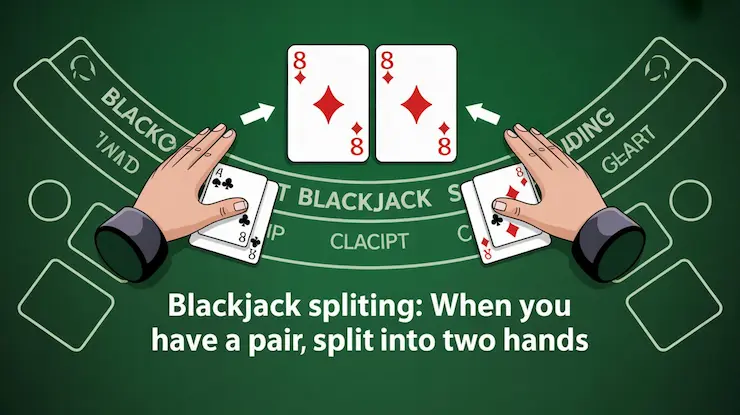
Players use a blackjack split when they want to transform a single stake into a double bet by placing an equal wager on the second hand. After you’ve played your first hand, you can ask for a “hit” (a dealer deals you another card) until you form a winning hand or go over 21 (bust). Then, you do the same with the second hand.
How to Split in Blackjack
A blackjack split is crucial to getting ahead of the game. This move lets you avoid costly mistakes and double your earnings by transforming a single wager into two bets of equal value. We recommend that you always ask the dealer about the specific rules at the best online blackjack casinos, as some casinos allow for only one split, while others permit multiple splits.
Here’s how to split in blackjack at the table:
- The dealer deals two cards of the same value
- You split your cards into two hands
- Place your original stake on the initial hand
- Add an equal wager to the split hand
- Play the hand to your right until you’re satisfied, reach 21, or bust
- Play the second hand and keep hitting until you win or go over 21 (bust)

Djordje TodorovicCasino Expert

Blackjack Split Rules and Table Variations
Blackjack split rules depend on table variations and may differ from table to table. However, one thing remains the same – the rules still let you turn one hand with the same cards into two separate hands. Here are some key splitting rules to keep in mind.
- Same Value Requirement: You can only split a hand made up of two cards of the same value, such as 8s or 10s. It’s the numerical value of the cards that matters.
- Second Bet Required: If you request a blackjack split, you’ll need to make another wager equal to your original stake. Since you’re now betting on two hands, you must make two equal bets.
- Playing Each Hand Separately: Make your move on each hand one at a time. After a split, you can hit (ask the dealer for another card) until you form a winning hand or bust (go over 21).
- Splitting Aces: Splitting aces in blackjack comes with a few limitations compared to a regular blackjack split. You won’t be able to hit again, and the dealer will deal only one additional card for each ace. If the additional card is 10, you’ll have a winning hand, but the payout will be 1:1 instead of the typical 3:2.
- Re-Splitting Options: You can opt for a re-split at some tables if the dealer deals you another pair. However, the re-splitting rules may vary from casino to casino, so check before placing a bet.
- Doubling Down After Split: Knowing when to split and double down in blackjack helps you avoid costly mistakes. You can hit or double down after a split on your original hand and double your initial wager before you receive an additional card. You’ll receive only one card before the dealer settles all wagers. The only exception is if you’re splitting two Aces.
Rule Variations by Game Type
There are many blackjack variants out there, and each comes with unique game rules on splitting and doubling down. Below, we’ve created a comparison table, giving you an overview of the rule variations by game type.
| Blackjack Variant | Aces Re-Split | Double After Split | Notes |
|---|---|---|---|
| Standard Blackjack | ✅(often/common) | ✅ (common) | One card only per Ace |
| Spanish 21 | ✅(common) | ✅ (common) | Double down on any number of cards in the split hand, including Aces |
| Double Exposure Blackjack | ❌(not allowed) | ❌(not allowed) | Some DEB variants only allow doubling down on 9,10, or Ace |
| Blackjack Switch | ❌(not allowed) | ✅ (common) | No double down after splitting Aces |
| European Blackjack | ❌(not allowed) | ❌(not allowed) | Splitting aces is allowed only once |
| Premium/VIP Blackjack | ✅(rare) | ✅ (common) | One card only per Ace |
Pairs You Should Never Split
Knowing when not to split in blackjack is equally important as knowing when to split a pair or double down. Below, we’ll state the scenarios where you should never split according to the standard blackjack basic strategy.
Never Split 10s or Face Cards
If the fortune favors you with a pair of 10s, never split such a hand. You already have a strong start and should use such a powerful hand to gain the edge over the dealer and secure high returns. So, we recommend standing on 20, as it’s only second to 21 – the best possible hand in the game. The expected value (EV) for standing on 20 is +0.70, meaning it pays out 70¢ per $1 bet. Splitting 10s reduces the EV to +0.20-+0.25, so you do the math.
Splitting 10s in blackjack or face cards might be a losing move as it reduces your winning chances. Since they form a hand of 20, you already have a strong position. Splitting such a pair could form two weak hands, significantly increasing the risk of losing.
Never Split 5s
We never split a hand with two 5s or 6s, unless the dealer pulls a 5 or 6 against your pair of 4s. It’s more profitable to double down on a pair of 5s, especially if you’re looking at a scenario with a higher payout on the layout. On the other hand, two 6s have a greater chance of turning into two 16s, additionally increasing your chances of forming a winning hand.
From the mathematical point of view, a hand with two 5s leaves you with 10 in total. In that case, we recommend doubling down instead of splitting. Why? Splitting 5s could result in getting two weaker hands, lowering your chances of winning.
Don’t Split 4s Except Against Dealer 5 or 6
If the dealer has a 2, 3, 4, 7, 8, 9, 10, or Ace, you should hit instead of splitting. You should only split if the croupier pulls a 5 or 6. The chances the dealer will bust if they have a 5 or 6 are 42%. So, you still have a good chance of winning, unless you bust. Even more so if you’re allowed to double down after a split.
A hand with two 4s leaves you with 8 in total. Though it’s not the best hand possible, it’s still a solid start to either double down or hit. The only situation where a split could mathematically work to your advantage is if the croupier draws a weak card (2-6).
Blackjack Split Chart
A blackjack split chart is a simple table showcasing mathematically best hand decisions based on the dealer’s upcard. In case you’re stuck and don’t know how to play your next hand, a basic blackjack chart can help you inform your decision before splitting. Our chart applies to online blackjack standard rules where DAS is allowed, and is valid for any game with a standard number of decks.
| Your Pair | Dealer’s Upcard | Recommended Action |
|---|---|---|
| Aces | Any | Always Split |
| 8s | Any | Always Split |
| 10s or Face Cards | Any | Never Split |
| 9s | 2-6,8-9 7,10, Ace | Split Do Not Split |
| 7s | 2-7 8-Ace | Split Do Not Split |
| 6s | 2-6 7-Ace | Split Do Not Split |
| 5s | Any | Never Split, Double Down Instead (if possible) |
| 4s | 5-6 2-4, 7-Ace | Split Do Not Split |
| 3s | 2-7 8-Ace | Split Never Split |
| 2s | 2-7 8-Ace | Split Never Split |
Pros and Cons of Splitting in Blackjack
A blackjack split can help transform a losing pair into a winning hand, significantly improving your chances of winning. It could also help you balance the risk when the dealer leaves you with a weak hand. However, it can also be quite harmful. Here are the pros and cons to help you make an informed decision.
What we like
- Transform a weak pair into two strong hands
- Improve your winning chances with a double bet
- Reduce the risk of a bust to avoid loss
- Maximize your earnings by potentially winning both hands
What we dislike
- You could lose both hands to a weak splitting decision
- You must double your bet, leading to higher losses
Final Verdict on Splitting
Splitting in blackjack helps you win by forming a winning hand, but only if it’s done right. You should always split 8s and Aces to avoid losing to a weak hand (e.g., 16) and increase the chance of winning by forming two powerful hands. If a croupier pulls 2-7, split your pair of 2s, 3s, and 7s. Additionally, if the dealer shows 2-6 and you’re looking at a pair of 6s, split your cards to beat the weak combo of 12 and increase the winning probability.
However, keep your 9s together when facing the dealer’s upcard, such as 7, 10, or Ace. Splitting 9s only works when the croupier pulls 2-6 or 8-9. If you’re not sure what to do in a given situation, consult our blackjack split chart to make the best move possible.