Fact Checked by



Top 5 Betting Strategies for Horse Racing Betting
Horse racing betting can be both fun and potentially profitable, thanks to the fast pace of the action and the huge number of race meetings held throughout the season. With so many opportunities to spot value and follow form trends, it offers bettors a dynamic and engaging experience.#1 – Win, Place, Show – Betting on Horses for Beginners
When betting win, place, and show (also known as across-the-board), you’re simply backing a horse to finish first, or to finish in the top two or three for smaller but safer returns. The best horse racing bets for beginners require you to understand the form card, which gives you the key information needed to judge a horse’s chances. Look at five basics: the horse’s recent finishing positions, the class level it is competing at, its speed figures, the trainer and jockey stats, and whether the horse has shown good form at the distance and track conditions.
Class of Race
If a horse has been placed on its last race and is moving from a maiden special weight to a maiden, it will be up against weaker opposition and therefore has a chance of winning as a class dropper. Look for horses that have run well in higher classes, but have not won, and are dropping in class.Why Gate Draw is Important
Gate draw can affect a horse’s chances negatively, especially if it’s an early speed horse drawn widest of all. If you are backing a speed horse, look for a low to middle draw. If a speed horse is drawn wide, it may need to expend extra energy to take the lead, meaning it will lack stamina at the end of a race.Speedster or Closer
Speedsters are dangerous if there is no pace pressure, while closers love an early pace duel. Always assess how a race will be run. A good strategy is to look for lots of speed drawn inside, which will create a pace duel. Closers (horses that finish strongly) drawn wide will likely drop in behind the speed. These horses can take advantage of speed duels where the leaders will tire late on.Viewing Jockey Stats
It’s never a bad thing to be on a jockey who rides a track particularly well. Many US form cards will have key jockey stats. One thing to always look for is the win percentage of the jockey when riding for a certain trainer. If you research properly, you will see jockey/trainer combinations that have high percentage strike rates.Viewing Trainer Stats
Similarly, some trainers will have a higher strike rate at some tracks than others. Barn form is also worth keeping a close eye on. Look for trainer records over the last 14 days. A high win and place strike rate will tell you that a trainer’s horses are thriving. Always look at trainers’ records when they stretch horses out from one turn to two turns. A great strategy for picking possible longshots.#2 – Dutching Horse Racing Betting Strategy
Dutching is a staking method in betting where you back multiple selections in the same market and adjust your stake on each one so that you lock in the same profit no matter which of them wins. The simplicity of this horse race betting strategy means that it can be used by both beginners and more advanced horse racing bettors.2 Horse Dutching
Two-horse dutching simply involves backing two horses in the same race. This horse race betting strategy is often deployed in small-field races where some of the runners can be discounted, or there is a short-priced favorite or famous racehorse that you are keen to oppose. In the image below, we’ve shown the returns of a combined stake of $100 on two horses with odds of 3.2 and 3.8.
3 Horse Dutching
A three-horse Dutch is an expansion of the two-horse horse racing bet strategy. Below, we’ve made three selections with odds of 3.5, 4.7, and 6.5, totaling a stake of $100. As you can see, the total returns are $153.30, should one of the three selections win.
#3 – The 80/20 Profitable Horse Racing Strategy
The 80-20 strategy is another simple approach that requires splitting stakes (80% on one horse, 20% on the other) across two horses. This can be on two horses in the same race (effectively dutching), or in two different races. Bettors divide their total stake by placing 80% on the shorter-priced runner and the remaining 20% on the outsider. The aim is to balance the potential returns, so whichever horse wins, the payout is roughly the same.#4 – Horse Race Betting Strategy – Exotic Bets
Exotic bets are any wagers beyond a simple win/place/show. They involve multiple selections, combinations, or predicting finishing orders. Here are some of the most popular types.Exotic Bets – Trifecta Betting
A trifecta bet is a type of exotic wager where you must predict the first three finishers in a race in the exact finishing order. Because of its difficulty, trifectas usually offer much higher payouts than straight bets like win, place, or show.Use a ‘Key Horse’
This is the most profitable trifecta technique over time. Choose one reliable horse to finish in a specific spot (usually 1st or 2nd) and rotate others around it. The best way to use a key horse is to pick one that is in the top three in the betting.Avoid Boxing Too Many Horses
A big box looks safe, but it’s usually a bad value trap. For example, a 6-horse box = 120 combinations. You’ll need a monster payout just to break even. If using a 6-horse box, try this strategy. Add in a first or second favorite, add in two horses between 4/1 and 10/1, add in two horses between 11/1 and 20/1, and have one big longshot. This combination of odds gives you a chance of having a safe, profitable return, and a possible huge payout if the favorite finishes off the board.Target Races With Volatility
Trifectas pay best in races where the market is uncertain. Large fields, maiden races, turf sprints, and two-year-old races are all good options, as are races with multiple speed horses (pace meltdown potential). Small fields or races with a heavy favourite often produce low, unprofitable trifectas. Aim for races that have 12 or more runners where the favorite is at least 3/1.Straight Trifecta Betting
A straight trifecta is the most basic (and toughest) form of a trifecta bet. You must select the first three finishers in the exact order, with no variations or combinations. TIP: Because these bets are so difficult to get paid on, it’s best to focus on logical Horses, not huge outsiders. To make this a profitable horse racing betting system, you should focus on one strong favourite, one mid-price horse, and one value runner (not a no-hoper).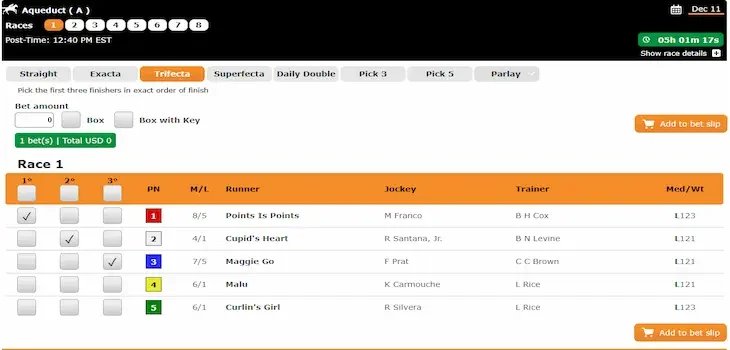
Box Trifecta Betting
A box trifecta is a type of trifecta bet where you select three or more horses, and every possible finishing order among your selections is covered. As long as any three of them finish 1st, 2nd, and 3rd in any order, you win. TIP: One of the biggest mistakes is to box up too many selections because it destroys value. A three-horse box is ideal if you have a strong opinion, while a four-horse box can be fine in uncertain races. 5+ selections in a box trifecta is likely to be poor value unless you are combining outsiders.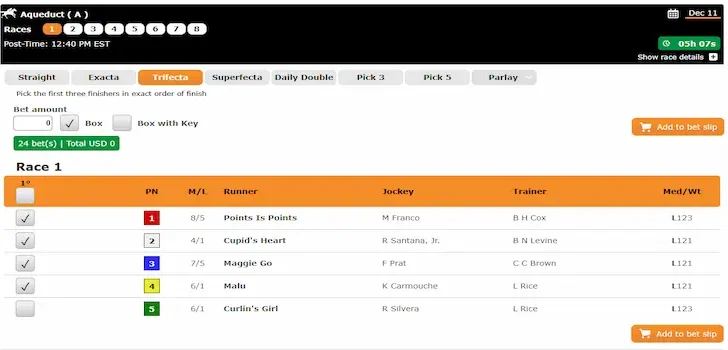
Key Box Trifecta Betting
A Key Box Trifecta (often called a Trifecta Key Box) is a type of trifecta bet where you choose one “key” horse that must finish in the top three, and then box it with two or more other horses, covering every finishing-order combination among them. TIP: Try to avoid short-priced horses underneath because it will just lead to a small payout. An ideal mix is one favorite, one mid-priced horse, and an outsider with a realistic chance. The value in this bet comes from one of the minor places being filled by a horse the market overlooked.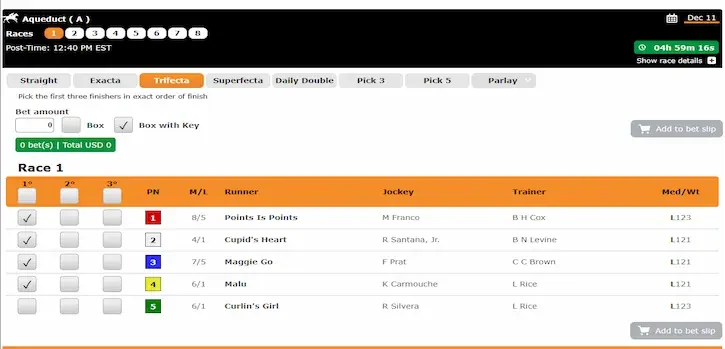
Exotic Bets – Superfecta Betting
A superfecta is an exotic racing bet where you must predict the first four finishers in the exact order. Because you’re adding an extra finishing position, the combinations explode, creating some of the biggest payouts in racing, making it one of the best bets for horse racing. There are several variations of a superfecta, including Superfecta Box, Superfecta Key, Superfecta Part-Wheel, and Superfecta High-5.- Tip 1 – Never bet a straight superfecta unless the race is extremely predictable
- Tip 2 – Use a “Key” horse to control stakes. This reduces the number of combinations dramatically while keeping the payout potential huge.
- Tip 3 – Target races with chaos potential. Superfecta payouts explode when unexpected horses sneak into 3rd or 4th.
Kentucky Derby Superfecta Betting
The Kentucky Derby offers one of the best superfecta wagering strategies because it has thrown up life-changing dividends on several occasions. Here are three of the biggest:- 2022 (won by Rich Strike) – $1 Superfecta paid $321,500.10
- 2009 (won by Mine That Bird) – $1 Superfecta paid $557,006.40
- 2005 (won by Giacomo) – $1 Superfecta paid $864,253.50
Straight Superfecta Betting
A straight superfecta is the most basic (yet most difficult) version of a superfecta bet in horse racing. You must pick the exact horses to finish 1st, 2nd, 3rd, and 4th – in the precise order. A straight superfecta costs the minimum unit set by the track, which is usually $1.
Box Superifecta Betting
A Box Superfecta is a bet where you choose four or more horses, and you win if any of your selections finish 1st, 2nd, 3rd, and 4th in any order. Instead of predicting the exact finishing order (like a straight superfecta), you cover all possible combinations of those horses. Therefore, if you box four horses, there are 24 combinations, making the total stake 24x your unit.
Key Box Superfecta Betting
A Key Box Superfecta lets you “key” one standout horse – your most confident pick – and then “box” several others around it for the remaining positions. One key horse must finish in the top 4, while the remaining three or more other horses must fill the remaining top-four spots, in any order. BONUS TIP: Very open races offer the best opportunities for big wins. These are races where the outcome is by no means straightforward, so big fields (12+ runners), turf sprints, young or lightly raced horses, sloppy/wet tracks, and spread-out odds (no dominant favourite) are all circumstances that can create explosive payouts.
#5 – Pick 5 Betting Horse Racing Strategy
A Pick 5 is a wager where you must correctly select the winners of five consecutive races at the same track. You pick one or more horses in each of the five races. To win, your ticket must hit all five winners. Miss even one race and the bet loses. It’s similar to a Pick 3 or Pick 4, but harder and with much bigger payouts.Pick 5 Straight Betting
The simplest way to play Pick 5, but also the hardest. You select ONE horse in each of the five consecutive races, and all five must hit to win. Remember, this is a choice-based bet, so only bet when the sequence of races suits you. Ideally, avoid Pick 5s that include chaotic races, large fields, maiden races, and low-level claiming races featuring inconsistent horses.
Pick 5 Combination Betting
A combination Pick 5 – often called “spreading” – means you use multiple horses in one or more legs, increasing your chance of hitting the sequence. Your ticket cost = number of horses you use in each leg multiplied together × bet amount (usually $0.50). An example might be 3 x 2 x 1 x 2 x 3. This would give you 36 lines x $0.50 for a stake of $18.00 The most important profitable horse racing strategy in combination bets is to make sure you anchor on one or two “singles”. Identify one or two legs where you’re confident in a standout horse and single that horse. Save your combinations for the other, less clear legs. This keeps costs under control while still giving good coverage.How Does Horse Racing Betting Work?
If you can combine a deep understanding of horse racing, the individual horses in any given race, and the way races are likely to be run, with the ability to utilize any of the available bet types, then you have a good chance of building a successful horse racing betting strategy. Before you decide what type of bet to place, make sure you have a good knowledge of a horse’s form, the surface they are running on, the class and distance of the race. There are many other notable variables to take into consideration, such as trainer/jockey form and their records at specific tracks. Once you have that base knowledge, you are in a position to assess which betting medium will enable you to generate a profitable horse racing strategy. Here are the three main options:- Pari-mutuel betting – This is pool betting, which is the predominant form of betting at US racetracks. These tend to offer bigger odds on outsiders.
- Exchange betting – Peer-to-peer betting that enables you to set your own prices. You can also bet horses to lose, by “laying” them. This is particularly useful if there is one horse that you are dead set against. Exchanges also facilitate horse racing betting in running – something you won’t find anywhere else.
- Fixed odds betting (Vegas) – This takes away the uncertainty that exists in pari-mutuel betting because you can take a set price at the time of your wager.
What Are the Best Horse Racing Bets?
There are many different ways to bet on horse racing. The simpler the bet, the more suitable it is for a beginner, while exotic bets appeal to more advanced handicappers looking to maximise the returns on their expertise. Here are some of the most popular bet types:Win BetPlace BetShow BetAcross The BoardDaily DoublePick 3 & Pick 4Exacta
A win bet in horse racing is the simplest and most common type of bet; You simply select a horse to finish 1st. It must win the race for the bet to pay out, so if it finishes 2nd, 3rd, or anywhere else, the bet loses.
A place bet in horse racing is a wager on a horse to finish in one of the designated “place” positions – not necessarily just to win. The number of places paid depends on the field size and/or race type. For example, in a ten-runner claiming race, there would typically be three places on offer, so your selection must finish in the first three.
A show bet is a low-risk wager (min stake $2) where you bet on a horse to finish in the top three. If you place a $10 show bet and the horse finishes in any of the top three positions, with a show dividend of $2.90, then you would receive $14.50 (5 x 2.90).
An Across The Board (ATB) bet is a single wager that combines three separate bets on the same horse: win, place, show – so you are effectively betting Win + Place + Show all at once. A $10 ATB bet would therefore cost $30 in total. The total return depends on where the selection finishes – if it wins, then you would receive payouts from all three outcomes, making it one of the best horse racing bets. A place would net you the place & show dividends, while a show would net just the show dividend.
A Daily Double is a horse-racing bet where you must pick the winners of two consecutive races (usually Race 1 & Race 2), although tracks can offer “late doubles” in later races. It’s one of the most popular exotic wagers in North American pari-mutuel racing.
A Pick 3 is a bet where you must select the winners of three consecutive races, and four for the Pick 4. The cost of the bet depends on the number of selections you make, so two selections in each of the Pick 3 races, at a $1 unit stake, would cost $8 (2 x 2 x 2).
In an exacta bet, you pick two horses that must finish first and second, in the exact order of your selections. Tracks publish exacta returns – with the dividend being the total pool amount divided by the number of winning tickets.
Horse Racing Live Betting on Exchanges
Betting exchanges such as Betfair are platforms where you bet against other players, not against the house. It works more like a financial marketplace than a traditional sportsbook or racebook. Since it’s peer-to-peer, the exchange doesn’t set horse racing best odds or take risk; they simply charge a small commission (typically 2–10%) on net winnings. Exchanges allow players to trade their way into profitable positions that can be locked in – this is a scenario known as ‘Greening up’. If you bet a horse at 7.2 in the morning, and the horse is trading at much shorter odds just before post time, then you will be able to make a lay bet that guarantees a profit on the race, no matter which horse wins.Major Horse Racing Events to Bet On
Horse racing fans in the US are spoiled for choice when it comes to big races and meets throughout the year. Races like the Kentucky Derby (first run in 1875) have long been staples of the racing diet, but in recent times, meetings like the Breeders’ Cup, regarded by many as the Olympics of horse racing, have become huge events since being launched in 1984.| Horse Racing Meet | Racetrack | Dates |
|---|---|---|
| Pegasus World Cup | Gulfstream Park | January 24th 2026 |
| Santa Anita Handicap | Santa Anita | March 7th 2026 |
| Arkansas Derby | Oaklawn Park | March 28th 2026 |
| Kentucky Oaks | Churchill Downs | May 1st 2026 |
| Kentucky Derby | Churchill Downs | May 2nd 2026 |
| Preakness Stakes | Pimlico | May 16th 2026 |
| Belmont Stakes | Belmont Park | June 6th 2026 |
| Arlington Million | Arlington | August 9th 2026 |
| Travers Stakes | Saratoga | August 22nd 2026 |
| Breeders Cup | Keeneland | October 30th – 31st 2026 |
Readwrite’s Free Horse Racing Betting Tips for Beginners
Readwrite’s expert horse racing team has come up with five tips that will ensure those who know very little about how to win at horse racing can start growing their betting bank.- Be a form guru – This doesn’t even need to be that in-depth. Focus on what horses have shown to be their ideal set-up in terms of track, surface, pace, grade, etc. You can then assess how likely they are to run to their best this time.
- Stick to simple bets – There is no need to go exotic too early. Focus on win, place, and show bets or win or each-way bets on fixed odds sites.
- Discipline is key – If you find you are betting in every race, you are in trouble. Be selective with your bets, and manage your bankroll like it’s gold dust.
- Look for value – Look for horses that you feel have a better chance than the odds imply, rather than just blindly siding with the top of the market. (See the section directly below for more information on this.)
- Keep notes – Evolve as a bettor by understanding what works for you and what doesn’t. Track which types of races or angles you understand best.
How to Find Value Horse Racing Bets
There are no shortcuts here; finding value in your horse racing betting system involves time and effort. When you look at a horse race, you shouldn’t be asking yourself, ‘Which horse is most likely to win?’ Instead, try to get into the mindset of looking for runners that you believe have a better chance of success than the odds imply. This is value, and it’s completely subjective. Here are five factors that will help you find value when assessing a horse race.- Understand what value is – Think percentages. If you believe a horse has a 50% chance of winning, then you would expect to see odds no bigger than 2.0. So, if you see bigger than that, say 2.4, on a sportsbook, then you have found a value bet.
- Calculating value – This isn’t as difficult as it sounds – just stick to decimal odds. If a horse is trading at 3.0 on the sportsbook, then that implies a 33% chance of winning (1 / 3.0). To calculate the level of value, use this formula: Value = (True Probability × Odds) – 1. So, if you believe this horse has a 45% chance of winning, then your edge would be xx (0.45 × 3.0) − 1 = 0.35. That’s a theortical 35% edge over the market.
- Key form factors – Recent form, track/distance record, pace setup, trainer/jockey performance, and surface conditions are the most important and reliable factors. The more boxes ticked, the stronger your chances.
- The value often lies in the early prices – Morning Line markets on sportsbooks are your best chance of spotting inefficiencies that would normally be corrected through the day. This means that you need to do your prep early.
- Don’t ignore bankroll management – The best way to bet on horses and ride variance swings is to be religiously strict with your betting bank. Value bets pay off in the long term, so you must stay in the game.